 (Rafa’el)
Foreign Correspondent – Europe
Daily Capital Mail
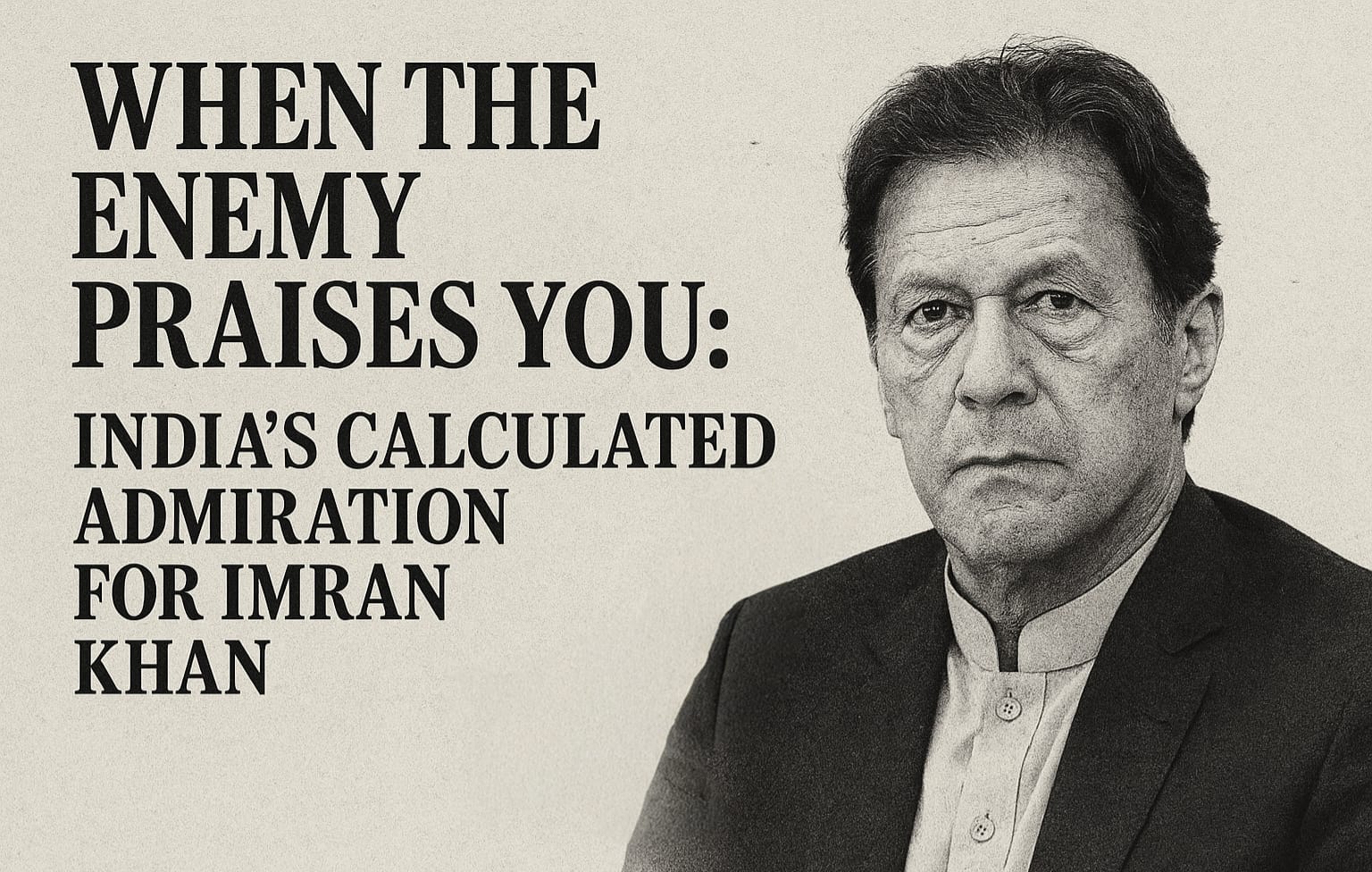
India’s political and media landscape has long been defined by a consistent hostility toward Pakistan. From diplomatic forums to newsrooms, New Delhi has historically seized every opportunity to distort Pakistan’s image and erode its credibility. Yet one figure has repeatedly received a strangely soft, almost protective tone from India’s most aggressive broadcasters: Imran Khan.
This unlikely admiration poses an uncomfortable question for Pakistan: Why would a country that openly seeks to weaken you, cheer for one of your leaders? In geopolitics, praise from an adversary is rarely a compliment—it is a warning.
Throughout Imran Khan’s tenure, a clear pattern was visible. Indian media was unusually warm in its coverage, amplifying his speeches, defending his political manoeuvres, and portraying him as a peaceful statesman in contrast to Pakistan’s traditional institutional posture. For a country that has weaponised narratives against Pakistan for decades, this sudden affection was not accidental.
Imran Khan’s leadership style was charismatic but predictable—largely driven by emotion rather than deep policy. His governance in Khyber Pakhtunkhwa remained shallow, particularly in addressing militancy and intelligence gaps. Institutions weakened under confrontational politics, and Pakistan’s internal polarisation reached unprecedented levels. All of this served India’s strategic interests far more than Pakistan’s.
The 2019 Balakot crisis revealed the full extent of India’s comfort. After Pakistan responded militarily and shot down an Indian aircraft, New Delhi braced for escalation. Instead, Imran Khan swiftly announced the release of the captured pilot, Abhinandan Varthaman. Indian media erupted with praise, celebrating a decision they interpreted as political softness at a moment when Pakistan required firmness.
For India, this was ideal. A Pakistani prime minister perceived as reluctant to engage in hard retaliation gave New Delhi greater room to pursue its own aggressive regional agenda.
Kashmir was another decisive moment. When India revoked Articles 370 and 35A, effectively altering the demography and political status of occupied Kashmir, Pakistan expected a strong, unified response. What followed were speeches, not strategy. India faced no meaningful diplomatic pressure, no global mobilisation, and no concrete counter-narrative from the Pakistani government. For New Delhi, this silence was an unexpected gift.
Meanwhile, Pakistan descended into internal chaos—civil-military friction, economic collapse, administrative paralysis, and deep political division. India watched closely, recognising that a fragmented Pakistan presented minimal diplomatic or military challenge.
The metaphor often echoed in political circles—that India sees Imran Khan as “its own revolving door”—captures a wider sentiment. Not literal espionage, but the strategic advantage India enjoyed from his style of governance. A Pakistan divided, weakened, and domestically distracted provided India exactly what it wanted: reduced pressure on Kashmir, limited international scrutiny, and a politically isolated Islamabad.
When Imran Khan was removed from office, Indian media’s reaction spoke volumes. Anchors expressed disappointment and anxiety, openly discussing how his fall might restore institutional stability in Pakistan. For India, a strong, united, policy-driven Pakistan is far more dangerous than a charismatic but divisive leader.
This leads to a final, unavoidable question: Did Imran Khan ever truly operate as a Pakistan-first statesman? A leader who prioritises national interest strengthens institutions, unites the country, and confronts external threats with strategy—not slogans. Under Imran’s rule, Pakistan became internally unstable, diplomatically passive, and strategically predictable. No genuine Pakistan-first policy can emerge from such conditions.
India’s admiration for Imran Khan should not be seen as respect. It should be understood as a geopolitical warning. When your rival celebrates your leader, it is not because he strengthens you—but because he serves their interests, directly or indirectly.
Imran Khan had more public support and emotional power than any Pakistani leader in decades, a diehard fan base that could have enabled real national reform — but he couldn’t convert that strength into stability or strategy. And that failure, more than anything, is what quietly benefited India. The uncomfortable question now is simple: if even he couldn’t rise above politics to put Pakistan first, then what must actually change for the country to stop giving its rivals an advantage?
For Pakistan, this is a lesson in political clarity and strategic sobriety. Enemies praise only when they feel safe.
For feedback or correspondence, please contact: Tahirmasood2024@gmail.com