DUBAI/ JERUSALEM,:
Israel launched a new wave of strikes on Tehran on Sunday, saying it aimed to dominate the skies after assassinating Iran’s supreme leader and leaving the Islamic Republic grappling to rebuild its leadership amid its biggest test in five decades.
US and Israeli strikes — and Iranian retaliation — sent shockwaves through sectors from shipping to air travel to oil, amid warnings of rising energy costs and disruption to business in the Gulf, a strategic waterway and global trade hub.
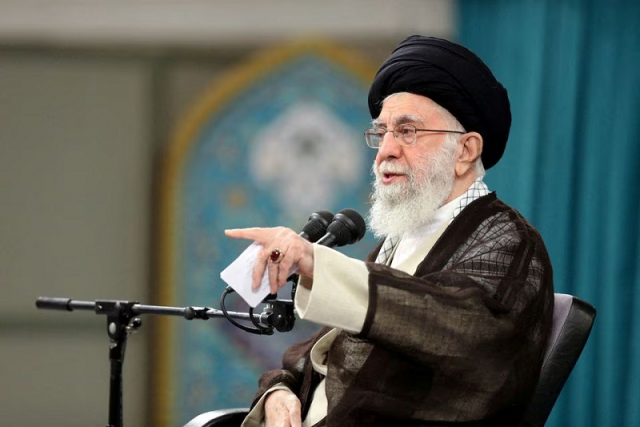
Iranian President Masoud Pezeshkian said a leadership council composed of himself, the judiciary head and a member of the powerful Guardians Council had temporarily assumed the duties of Supreme Leader following the death of Ayatollah Ali Khamenei.
The US military said it had sunk an Iranian ship, while Iran’s Revolutionary Guards said they had launched an attack on the US aircraft carrier Abraham Lincoln with four ballistic missiles, state media reported.
In a sign of widening turmoil, Israel’s ambulance service said nine people were killed by a missile strike in the town of Beit Shemesh, the United Arab Emirates said Iranian attacks killed three people and Kuwait reported one dead in Iranian raids.
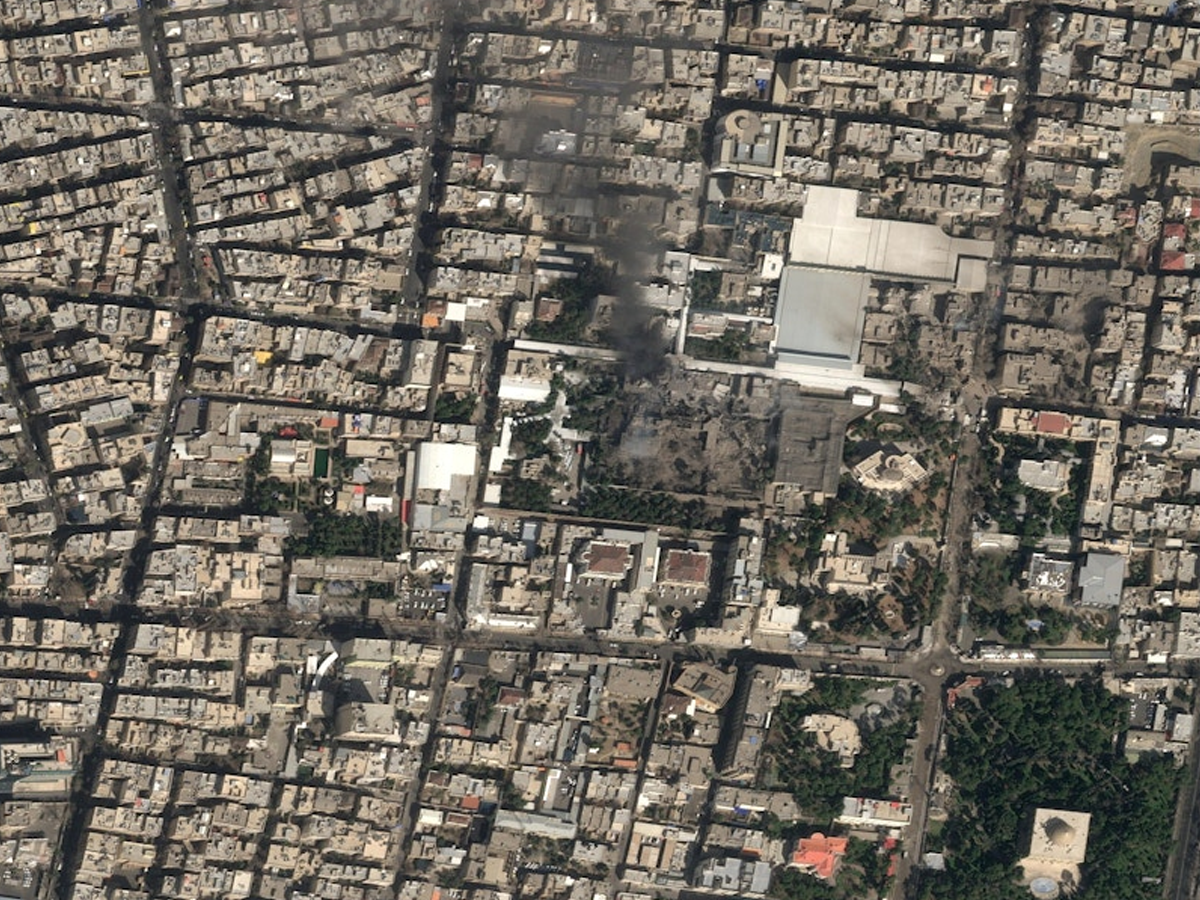
A satellite image shows black smoke rising and heavy damage at Iranian Supreme Leader Ayatollah Ali Khamenei’s compound, following strikes by the United States and Israel against Iran, in Tehran, Iran, February 28, 2026. Photo: Reuters
The Israeli military said that over the past day Israeli planes had conducted strikes to open the “path to Tehran”, and the majority of aerial defence systems in western and central Iran had been dismantled.
It added: “Ali Khamenei was targeted in a precise, large-scale operation carried out by the Israeli Air Force, guided by accurate IDF intelligence, while he was in his central leadership compound in the heart of Tehran, where he was together with additional senior officials”.
Israeli military spokesperson Lieutenant Colonel Nadav Shoshani said many targets remained, including sites of military‑industrial production. “We have the capabilities and the targets to keep going on for as long as necessary,” he said.
Ground forces not being considered, Israel says
Asked if Israel was considering deploying ground forces, Shoshani said that was not under consideration even though US President Donald Trump and Israeli Prime Minister Benjamin Netanyahu have urged Iranians to seize a rare opportunity to topple their leaders.
Hours after the US and Israel said an air strike killed Khamenei, Iran’s state media confirmed the 86-year-old leader had died.
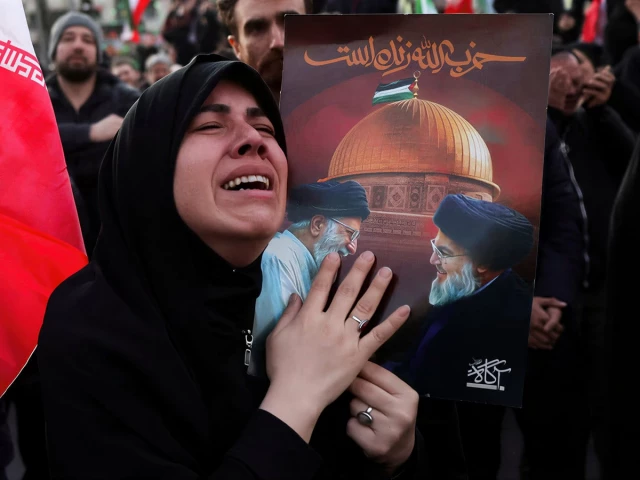
Inside Iran, some grieved for Khamenei while others celebrated his death, exposing a deep fault line in a country stunned by the sudden demise of the man who ruled for decades.
Thousands of Iranians were killed in a crackdown authorised by Khamenei against anti-government protests in January, the deadliest wave of unrest since the Islamic Revolution of 1979.
Footage from Tehran showed mourners packed into a square, dressed in black and many of them weeping.
But videos posted on social media also showed joy and defiance elsewhere, with people cheering as a statue was toppled in the city of Dehloran in Ilam province, dancing in the streets of Karaj city, near Tehran in Alborz province, and celebrating in the streets of Izeh in Khuzestan province. Reuters has verified the locations of these videos.
Khamenei, who built Iran into a powerful anti-US force and spread its sway across the Middle East during his 36-year iron-fisted rule, was working in his office at the time of Saturday’s attack, state media said. The raid also killed his daughter, grandchild, daughter-in-law and son-in-law.
Two US sources and a US official familiar with the matter said Israel and the US timed their attack on Saturday to coincide with a meeting Khamenei was holding with top aides.
Experts said that while his death and those of other Iranian leaders would deal Iran a major blow, it would not necessarily spell the end of Iran’s entrenched clerical rule or the sway of the elite Revolutionary Guards over the population.
As supreme leader, Khamenei held ultimate power in Iran, acting as commander-in-chief of the armed forces and deciding on the direction of foreign policy, defined largely by confrontation with the United States and Israel.
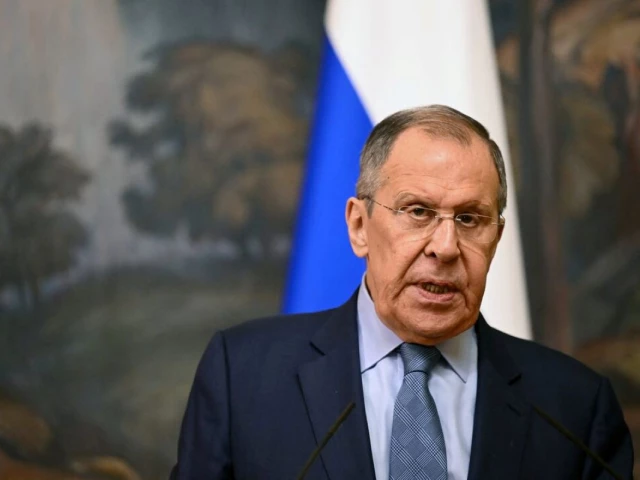
Russian President Vladimir Putin denounced Khamenei’s death, opens new tab as a cynical murder and China’s Foreign Minister Wang Yi described it as “blatant killing”, while European Union foreign policy chief Kaja Kallas said the death of Khamenei was “a defining moment in Iran’s history”.
After Iran retaliated with airstrikes around the Gulf, Anwar Gargash, adviser to the president of US ally and oil power the United Arab Emirates, urged Tehran to “go back to your senses”, saying the war is not with Iran’s Gulf Arab neighbours. The UAE has so far borne the brunt of Iran’s retaliation.
Trump warned on Sunday that the US would hit Iran “with a force that has never been seen before” if it strikes back after the attacks on it.
Iran vows ‘terrifying blows’
In a sign of disruption to energy supplies, at least 150 tankers including crude oil and liquefied natural gas vessels dropped anchor in open Gulf waters beyond the Strait of Hormuz and dozens more were stationary on the other side of the chokepoint, shipping data showed on Sunday, after the USand Israeli strikes.
The oil tankers were clustered in open waters off the coasts of major Gulf oil producers including Iraq and Saudi Arabia as well as LNG giant Qatar, according to Reuters estimates based on ship-tracking data from the MarineTraffic platform.
Read more: Iran targets US bases in Gulf after American, Israeli strikes kill 201, injure 747
In remarks directed at Trump and his close ally Israeli Prime Minister Benjamin Netanyahu, Iran’s parliament speaker Mohammad Baqer Qalibaf said “we will strike you with such terrifying blows that you yourselves will be driven to beg”.
“I say to Trump and Netanyahu and their agents and proxies, I repeat, I say to these two filthy criminals and to all their agents: you have crossed our red line, and you must pay the price for it.”
Khamenei had a following among fellow Shi’ites outside Iran in countries such as Iraq and Pakistan, which have the largest Shi’ite populations after Iran.
Experts said that while the deaths of Khamenei and other Iranian leaders would deal a major blow to the country, it would not necessarily spell the end of Iran’s entrenched clerical rule or the Revolutionary Guards’ sway over the population.
Trump warns Iran of unprecedented force
The United States will hit Iran “with a force that has never been seen before,” US President Donald Trump said, should the Middle East nation retaliate for US strikes.
“Iran just stated that they are going to hit very hard today, harder than they have ever been hit before,” Trump said in a post on Truth Social.
He added, “THEY BETTER NOT DO THAT, HOWEVER, BECAUSE IF THEY DO, WE WILL HIT THEM WITH A FORCE THAT HAS NEVER BEEN SEEN BEFORE!”
Failed negotiations
Israeli military operations over the past two years had already killed some of Iran’s senior military officials and severely weakened several of Tehran’s once-feared proxy forces across the Middle East.
After Israel pounded Iran in a 12-day air war in June, joined by the United States, the US and Israel had warned they would strike again if Iran pressed ahead with its nuclear and ballistic missile programs.
During the UN Security Council meeting on Saturday, envoys from Russia and China criticized the US and Israel for launching the strikes while Tehran was negotiating with Washington. Russia’s UN envoy Vasily Nebenzya said Iran had been “stabbed in the back” and disputed the US claim that preventing Iran from acquiring a nuclear weapon justified the attacks.
Senior US officials said on Saturday that the latest talks showed Iran was not willing to give up its ability to enrich uranium, which the Iranians argued they wanted for nuclear energy but US officials said would enable the country to build a nuclear bomb.