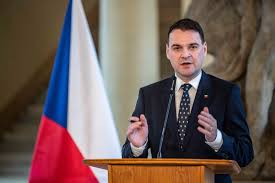
Your Excellencies, ladies and gentlemen, welcome to the Czernin Palace. Welcome to the Ministry of Foreign Affairs of the Czech Republic. And thank you for accepting my invitation to this meeting.
Let me begin by wishing you all the very best for the new year. May you enjoy good health and much happiness in your personal lives, and may our cooperation be mutually beneficial.
Allow me, as the foreign minister of the new government, to use this rare opportunity to briefly present the main accents and priorities of our foreign policy.
On the fundamental questions of our foreign policy, continuity remains. Good foreign policy does not change in a revolutionary manner, “from one extreme to the other”; it can, however, adjust its emphasis in response to changes in the international environment. Continuity does not mean that everything has to stay the same.
In terms of form, we have made a fundamental shift in foreign policy. It is no longer a policy of moralising and virtue signalling. It is no longer a policy of social media posts instead of diplomacy. The Czech state cannot and will not serve as a platform for activism.
We are bringing the national interest back to the centre of our diplomacy. We want to measure every decision against three simple questions:
Is it good for the security of the Czech Republic?
Is it good for our prosperity?
Is it good for the freedom of our citizens?
We are aware that the world and its order are changing. We all have ideas about what the ideal world should look like. But we have to work with the world as it is. The foreign policy of this government will therefore be more realistic, more pragmatic, and more restrained. Foreign policy will not be an instrument of domestic politics for this government.
Our communication of foreign-policy issues, both at home and abroad, will not be driven by the pursuit of media headlines. It will be tailored to the primary purpose of foreign policy: to smooth rough edges, to settle disputes, and to seek partners and allies—not the other way around. Diplomacy speaks through symbols. We must use them with great care and empathy, and without a lecturing or judgmental tone.
These are, in brief, the general principles of this government’s foreign policy. Now to be more specific.
Our core geopolitical frame of reference remains Europe and the transatlantic space, whose treaty foundations are the European Union (in the case of Europe) and NATO (in the case of the transatlantic space). We intend to continue operating within both of these frameworks—constructively, actively, and positively. At the same time, both face new challenges brought about by the new dynamics of the international environment.
In the case of the EU, we sometimes hear—especially from the European institutions—calls for deeper integration and centralisation, influenced by Russia’s invasion of Ukraine and by the changing nature of transatlantic relations. Political developments in a number of Member States, however, do not correspond to these calls. That is why we do not want to change the current balance between the European level and the national level. This balance is fragile and hard-won. For example, we do not support expanding qualified majority voting or reopening the EU’s founding treaties. As for NATO, we recognise the legitimacy of the demand for stronger involvement by its European members in building Allied defence capabilities—yet this must be aligned with their economic capacities.
Within Europe, we are geopolitically, historically, infrastructurally, and energetically bound to the Central European space—there is no escaping it. It is therefore our duty to maintain the highest-quality relations with our direct neighbours and other geographically close countries. This must also be reflected in our deep understanding of potential differences of opinion. With all due respect, we have no reason to adopt the “narratives” of countries from other parts of Europe that have undergone different historical experiences.
The importance and weight of non-European centres in the system of international relations is growing; a multipolar world has become a reality. For this reason, we want to devote more intensive attention to the non-European dimension of our foreign policy: to gradually increase the share of non-European markets in our trade balance, to make use of existing strategic partnerships (such as with South Korea and Vietnam), and to conclude new ones. We are aware that the global atmosphere is less favourable to dismantling trade barriers than it was not long ago, and that instruments to protect domestic markets are returning to the fore. We therefore need to make better use of the potential of trade agreements already concluded at EU level. In our transformation, development, and humanitarian policies, we will also work more with economic criteria and with measurable, attainable, concrete results.
Economic diplomacy will be among our key bilateral instruments.
Overall, our aim is both to gain commercial space in new, dynamically developing markets outside Europe (especially in Asia), and to contribute to the economic stabilisation of regions from which sources of instability may flow into Europe—for example in the form of illegal migration (Africa).
We want good—or at least normal—relations with key global partners and major powers. Above all, this means our long-standing partnership with the United States. The United States is now reshaping its priorities—towards Europe, the Western Hemisphere, and the wider world. So we have to take that into consideration. I must admit that the new approach of the President of the USA towards the so called cancel culture, woke revolution, and green alarmism is very close to the position of the new Czech government.
With China, we want to restore a standard level of relations that will fall within the European mainstream of many other countries in the EU.
Regarding Russia, a return to normal relations is very complicated as long as it continues its aggression against sovereign state of Ukraine. The new Czech Government will support any diplomatic steps with the aim of ending this conflict. I want to thank to my counterpart Andrii Sybiha for great hospitality during my visit to Ukraine. It was important to see the situation in Kyiv as well as the unity of Ukrainian people in their will to make the war over.
We also recognise the growing importance of India, Central Asia, and Southeast Asia.
In the Middle East, continuity remains in our traditional friendship with the State of Israel, as does our overall emphasis on negotiations and diplomatic solutions to conflicts, and on developing cooperation with partners in this important region who pursue the same objective.
Ladies and gentlemen, Your Excellencies, allow me to conclude, on behalf of the new government, by expressing our readiness for intensive cooperation and continuous dialogue.
I am very sorry I am not able to spend some more time here with you today, but due to our budget situation I will have to leave this gathering in some 30 minutes from now to be present at the emergency meeting of the Czech Government. I am sure my deputies will entertain you in the way you deserve.
Thank you for your attention.