KARACHI:
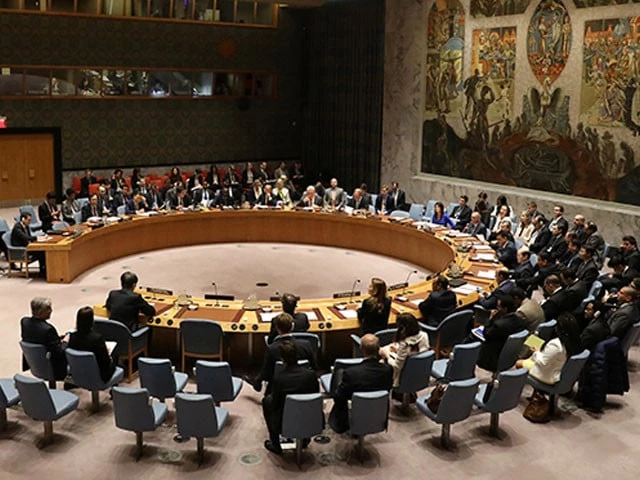
A United Nations Security Council (UNSC) report has said that attacks on Pakistan by the banned terrorist Tehreek-e-Taliban Pakistan (TTP) group from Afghanistan have increased, endorsing Islamabad’s long-running complaints about militant sanctuaries across the border.
The 37th report by the Analytical Support and Sanctions Monitoring Team, dated February 4, not only endorsed Islamabad’s stance that Afghanistan had become a sanctuary for militants who used its territory to launch attacks on Pakistan, but also came at a time when the country is facing a renewed spate of violence.
Last week, at least 33 people were killed and around 169 others were injured when a suicide bomber struck Imambargah Khadijah al-Kubra during Friday prayers. The security forces also concluded “Operation Radd-ul-Fitna-1” in Balochistan following coordinated attacks by terrorists. According to the military, 36 civilians, including women and children, were killed during the operations, while 22 personnel from the security forces and law enforcement agencies “made the ultimate sacrifice”. It said 216 terrorists were also “sent to hell”.
According to UN report, the presence of terrorist groups in Afghanistan remained a source of concern in Central and South Asia.
“There was an increase in attacks in Pakistan launched by TTP (Tehreek-e Taliban Pakistan) in Afghanistan, which led to military exchanges. Regional relations remained fragile. Islamic State in Iraq and the Levant-Khorasan (ISIL-K) was under sustained counter-terrorism pressure, but it retained a potent capability, coupled with intent to conduct external operations,” it said.
The report also highlighted concern among regional countries about the number of terrorist groups in Afghanistan and the spillover effects, including cross-border attacks and the radicalisation of vulnerable domestic communities.
It said Afghan de facto authorities claimed there were no terrorist groups within Afghanistan’s borders, yet, it said that “no member state supported this view”.
It further said: “The de facto authorities continued to act against ISIL-K and control the external activities of some other groups. TTP, however, was accorded greater liberty and support from the de facto authorities, and consequently TTP attacks against Pakistan increased, amplifying regional tensions.”
The report also said Al Qaeda continued to enjoy the patronage of the de facto authorities, and acted as a service provider and multiplier for other terrorist groups in Afghanistan through training and advice, principally to TTP.
It further added that the TTP operated as one of the largest terrorist groups in Afghanistan, and its attacks on Pakistani security forces and state structures led to military confrontation. Attacks were increasingly complex and, at times, involved large numbers of fighters, it noted.
The report cited an attack on an Islamabad courthouse on November 11 that resulted in 12 deaths and was claimed by a TTP splinter group. It described the incident as the first attack in the capital for several years and a departure from TTP’s previous targeting.
“Some member states expressed concern that TTP may deepen its cooperation with Al Qaeda-aligned groups in order to attack a wider range of targets, potentially resulting in an extra-regional threat.”
The report described Pakistan’s actions against TTP as a major setback for the group.
“TTP suffered several operational setbacks, notably the death of Mufti Muzahim (TTP deputy emir, not listed) in a Pakistani operation in October,” it said.
The report also drew attention to a series of attacks by the banned Baloch Liberation Army (BLA) against Pakistani security forces and projects linked to the China-Pakistan Economic Corridor (CPEC).
“On September 16, the BLA ambushed a Pakistani military convoy patrolling the corridor, killing 32 troops. While counter-terrorism operations by Pakistan restricted the BLA’s operational space, it remained active.”
It added that some member states reported the BLA collaborated with TTP and ISIL-K through shared training camps and resources, coordinating attacks and meetings between commanders. Some member states assessed there was neither an association nor growing ties between the BLA and Al Qaeda or ISIL.
The report said various groups in Afghanistan had acquired modern weapons and equipment through cross-border smuggling and black-market trade.
“TTP used advanced assault rifles, night-vision devices, thermal-imaging devices, sniper systems and drone attack systems. Most of these were provided by the de facto authorities in conjunction with weapons permits and travel documents,” it said.
However, the report underlined that several member states noted that continued proliferation of weapons from stockpiles left by former partners in the Global Coalition against Daesh had enhanced the lethality of TTP attacks against Pakistan’s security forces.
The report stated that member states remained concerned about potential flows of fighters, including from Central Asia, towards Afghanistan or Africa.
It said that, Al-Qaeda in the Indian Subcontinent (AQIS) remained active in south-eastern Afghanistan, where the Haqqani Network exerted considerable influence. Osama Mahmoud, the “emir” of AQIS, and Yahya Ghauri, his deputy, were reported to be in Kabul, with the media cell of AQIS based in Herat.
According to the report, ISIL-K remained under significant pressure, mainly from security operations by regional states, but retained strong operational capability and the ability to replenish its ranks, including through online recruitment,
The report said ISIL-K was able to rapidly replace fighters and sustain combat capability despite continued counter-terrorism operations.
“The pressure campaign pushed ISIL-K to search for alliances with other armed factions in different areas in Afghanistan,” it said.
It added that ISIL-K was active mainly in northern Afghanistan, particularly Badakhshan, and in areas close to the Pakistani border. The report said the group continued expanding its network of cells to project a threat within the region and beyond.
Separately, the report said members of the East Turkistan Islamic Movement/Turkistan Islamic Party (ETIM/TIP) were able to move freely in Afghanistan under the patronage of the de facto authorities.
“Under the de facto authorities’ patronage, which included the issuance of identity documents, ETIM/TIP members were able to move freely within Afghanistan and have gradually concentrated in Badakhshan,” it said.
According to one member state cited in the report, ETIM/TIP members raised funds from poppy cultivation and mining. The report said about 250 members were reported to have joined Taliban police forces in 2025.
It also cited one member state as saying ETIM/TIP in Afghanistan called on its members in the Syrian Arab Republic and neighbouring countries to relocate to Afghanistan in preparation for “returning to Xinjiang for jihad”.
The UN assessment said there was no information indicating any large-scale movement of foreign terrorist fighters from the Syrian Arab Republic to Afghanistan, although a few isolated cases were reported.
It said Central Asian states, in particular, remained concerned about the potential risk of Central Asian fighters moving to northern Afghanistan to plan attacks against their home countries.
The report also said there were reports that foreign terrorist fighters were trained in dedicated camps in Afghanistan’s Badakhshan province.
Pakistan’s allegations against Afghanistan, India of supporting terrorism
Pakistan has repeatedly pointed to an AfghanistanIndia nexus behind terrorism in the country. The interior minister said earlier this week that the mastermind of the attack was an Afghan citizen linked to Daesh.
In November 2024, Inter-Services Public Relations Director-General Lieutenant General Ahmed Sharif Chaudhry had issued a warning that the Afghan regime was a threat not just to Pakistan but to the entire region and the world, citing the abandonment of $7.2 billion worth of American military equipment during the US withdrawal.
Lt Gen Chaudhry reiterated that the Afghan regime was harbouring “Non-State Actors” who posed a threat to various countries in the region, noting the Taliban’s failure to establish an inclusive state and government post-2021. He stressed that Pakistan’s issue was with the Afghan Taliban regime, not the Afghan people.
After the conflict with India in May 2025, Field Marshal Asim Munir had said that Pakistan would never be coerced, and that all inimical designs to derail the country’s counterterrorism efforts would be “comprehensively defeated”.
Last year in August, the UN’s 1988 Taliban sanctions committee monitoring team annual report said outlawed terrorist groups – BLA, including its Majeed Brigade, and TTP had “close coordination”.
The report said regional relations remained fragile and that “there was a risk that terrorist groups might exploit these regional tensions.” It added that the TTP had approximately 6,000 fighters and continued to receive substantial logistical and operational support from the de facto authorities (the Taliban).
“Some member states reported that the TTP maintained tactical-level connections with ISIL-K or Daesh,” it said. “TTP continued to carry out high-profile attacks in the region, some of which incurred mass casualties,” the report added.
The UNSC report said “some BLA attacks showed a high degree of complexity and brutality”, citing the hijacking of the Jaffar Express in Balochistan on March 11, 2025, which killed 31 people, including 21 hostages.
In 2023, a UN report also revealed that the outlawed TTP had established a new base in K-P in mid-2023. The report shed light on close ties not only between the TTP and the Afghan Taliban but also with anti-Pakistani groups and al Qaeda.
The report further revealed that some Taliban members had also joined the TTP, perceiving it as a religious obligation to provide support.
Interlocutors reported that TTP members and their families received regular aid packages from the Taliban.
Importantly, the UN report noted a significant increase in Afghan nationals in the TTP ranks. This supported Pakistan’s stance that a growing number of Afghan nationals were involved in suicide attacks in the country.